Recipe search
SearchEngine.search runs a recipe over the graph and returns up to recipe.limit ranked results. A recipe is a named list of settings that says which search methods to run, whether to walk the graph, whether to add community reports, and whether to re-rank.
| Python function | SearchEngine.search(query, recipe, filters=...) |
| Built-in agent tool | None. The agent uses the evidence tools. |
| MCP tool | None |
| Required inputs | query and recipe. The engine needs a graph_store and an embedder. |
| Optional inputs | filters, a SearchFilters object |
| Returns | A list of SearchResult items. Each has an item, a score, and the method that found it. |
| Needs | The entity, chunk, and community indexes that ingestion creates. The embed-local extra for the cross-encoder re-ranker. |
| Reads | The stored graph. There is no document scope. |
| API reference | Retrieval API |
Overview
Use recipe search when your application wants entities, passages, or topic reports as data. Answers that cite sources use the evidence tools instead, because recipe search has no document scope and no citation support. An item in a result is an Entity, a ResolvedEntity, a Relation, a Chunk, or a Community.
Pick a preset from agrag.retrieval.recipes.
| Recipe | Methods | Extra steps | Results | Use it when |
|---|---|---|---|---|
ENTITY | entity | none | 10 | You want the entities that match a name or a description. |
CHUNK | chunk | none | 10 | You want source passages ranked by meaning and you do not need entities. |
HYBRID | entity, chunk | none | 10 | You want entities and passages in one list. It is the usual starting point. |
HYBRID_RERANKED | entity, chunk | community reports, cross-encoder re-rank | 10 | A cross-encoder model is available and you want it to re-order the candidates against the query. |
GRAPH_EXPAND | entity | graph walk, community reports | 20 | The query names an entity and you want its neighbors and the topic reports around it. |
THEMATIC | community | none | 5 | The query asks about the themes of the whole corpus. |
A recipe is data, so you can copy one and change its fields.
| Field | Default | Effect |
|---|---|---|
methods | required | The methods to run, by name: entity, chunk, or community. |
bfs | False | Run a graph walk after the methods, seeded from the entity results. |
bfs_depth | none | Hops of the walk. None uses RETRIEVAL_TRAVERSAL_DEPTH. |
reranker | none | cross_encoder or node_distance. None skips re-ranking. |
min_score | none | Drop results that the reranker scores below this value. None uses RETRIEVAL_RERANKER_MIN_SCORE. |
limit | 10 | The most results returned. |
community_expand | False | Fuse in the reports of communities that overlap the entities found. |
community_top_k | 3 | How many community reports to add, and how many slots they keep after a cross-encoder re-rank. |
A recipe that names a method outside the list raises UnknownRecipeMethodError, so a misspelled name raises an error and never returns an empty result.
Usage
In Python
The example uses the notes from Set up the example, and it reuses store and embedder from that page. The output comes from a real run. Search the notes with the HYBRID recipe and print the first four results:
from agrag.common.data_models.chunk import Chunk
from agrag.common.data_models.entity import Entity
from agrag.retrieval.recipes import HYBRID
from agrag.retrieval.search_engine import SearchEngine

engine = SearchEngine(graph_store=store, embedder=embedder)
results = await engine.search("Who wrote the Orion Planner?", HYBRID)
for result in results[:4]:
    item = result.item
    if isinstance(item, Entity):
        label = item.name
    elif isinstance(item, Chunk):
        label = item.text[:40].replace("\n", " ")
    else:
        label = ""
    print(f"{result.method:<7} {result.score:.4f}  {type(item).__name__:<7} {label}")
entity  0.0164  Entity  Orion Planner
chunk   0.0164  Chunk   Acme Robotics engineering notes  Route p
entity  0.0161  Entity  Orion
chunk   0.0161  Chunk   | Component | Owner | Purpose | | --- |
Entities and chunks come back in one list, and the method column tells you which method found each item. The planner entity ranks first, and the chunk that names its author ranks second. The entity Orion is the extractor's invented entity from the notes, and the recipe returns it like any other.
A recipe search returns items and no passage ids that you can cite. To answer with citations, use the evidence tools on the same documents.
Filters
A SearchFilters object limits a search to matching items.
| Field | Effect |
|---|---|
labels | Entity labels a result must have. Applies to entity search only. |
relation_types | Relation types a graph walk may cross. |
document_ids | Only entities and chunks from these source documents. Applies to entity, chunk, and community search. |
properties | Exact-match property filters. A list value means any of. Applies to entity, chunk, and community search. |
Filters limit what a recipe returns. They are not the document scope of the evidence tools, which the caller sets once and which the tools enforce inside every query.
Other engine calls
| Call | What it does |
|---|---|
find_entity(name, filters=...) | Resolves a name to its top entity hit, or None. |
traverse(seed, ...) | Expands one resolved entity into its neighbors, with relation_type, direction, depth, and limit. |
list_relationship_types(seed, ...) | Lists the relation types attached to an entity, at depth 1. |
search_candidates(query, ...) searches candidates that extraction kept out of the graph. It has no scope filter, so a scoped caller must not expose it.
How a recipe runs
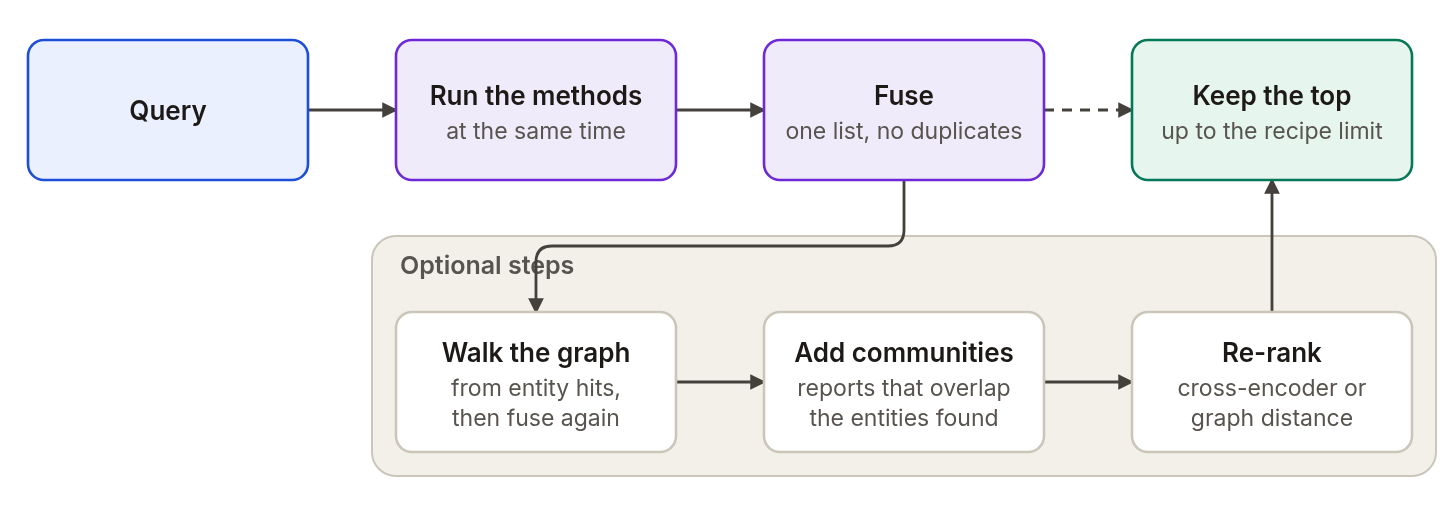
The steps in the box run only when the recipe asks.
- Run the methods. The engine runs the methods the recipe names at the same time. If one method fails, the others still return results. If every method fails, the engine raises
AllRetrievalMethodsFailedError. - Fuse. The engine merges the ranked lists into one list and removes duplicates.
- Walk the graph (optional). The engine follows relations outward from the entity hits and fuses the neighbors into the list.
- Add communities (optional). The engine adds the reports of communities that overlap the entities found.
- Re-rank (optional). A cross-encoder model, or the graph distance to the top entity hits, sets a new order.
- Cut. The engine keeps the top results, up to the limit of the recipe.
| Method | What it finds |
|---|---|
entity | Entities and resolved entities whose embedding is closest to the query. |
chunk | Passages of source text. Each hit is one chunk, with the headings above it. |
community | Reports on topics. |
Reciprocal rank fusion scores an item from its rank in each list and ignores raw scores. RETRIEVAL_RRF_K sets the constant for SearchEngine, and the evidence tools use a fixed constant of 60. An item found by several methods can outrank an item found by one method. Each method gives an item one vote at its best rank, so duplicate hits from one method add no weight. Fusion runs even when a recipe has one method, so the re-ranker never sees the same item twice.
With the cross-encoder, the recipe keeps up to community_top_k slots for community reports after the re-rank, so the re-rank cannot push every report out of the results.
One failed method does not fail the search. A timeout in one method must not hide good results from another, so the engine logs the failure and records it on the trace. With a positive limit, a method returns an empty list only when the search ran and found nothing, and it raises on any failure it cannot recover from.
Related
- Retrieve and answer runs a recipe search and an agent answer end to end.
- Communities explains the reports that the
communitymethod and theTHEMATICrecipe return. - Configuration lists the
RETRIEVAL_settings, includingRETRIEVAL_RRF_KandRETRIEVAL_RERANKER_MIN_SCORE.