Record decisions and review them
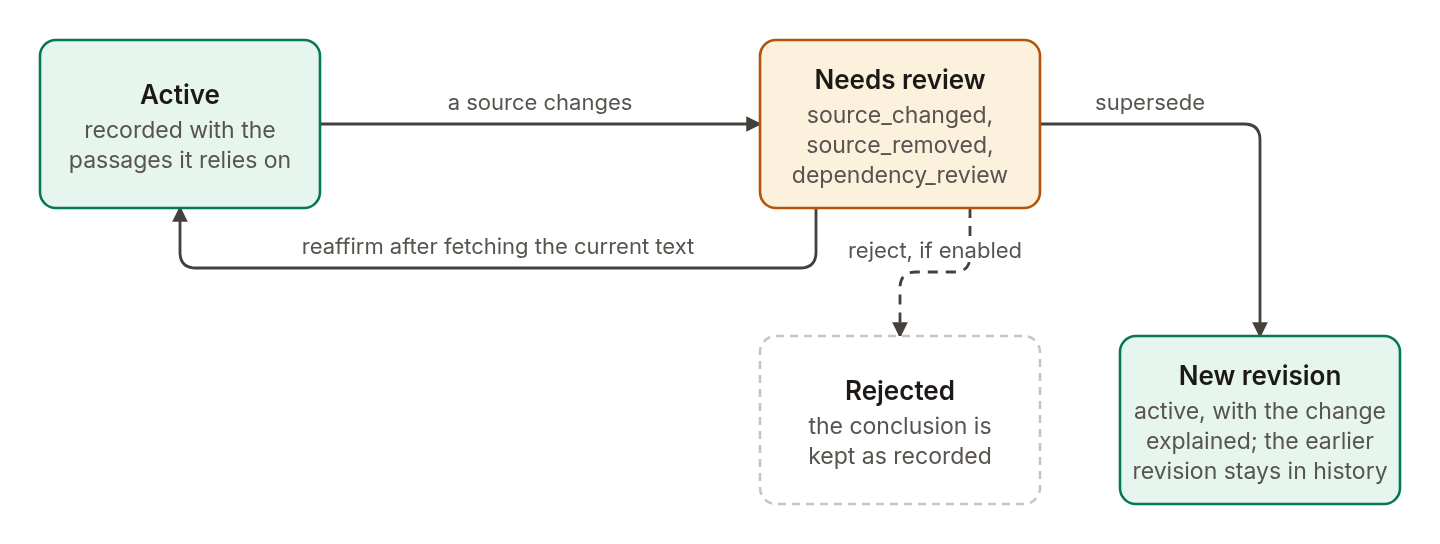
Record a decision that points to the passages it relies on. When a document behind the decision changes, Agentic GraphRAG flags the decision for review. You then reaffirm the decision against the current text, or replace it.
Before you start
- A running Neo4j and the
NEO4J_*variables. - The extras for graph storage and local extraction:
uv pip install "agentic-graphrag[neo4j,extract]".
The script creates or replaces policy.md in the current folder with a sample vendor policy. Run it in a separate example folder.
Add the document and record a decision
Memory belongs to a project. Open TaskMemory and DecisionMemory with the same project_id and an agent_id that identifies the author. A decision needs a task, so create the task first.
import asyncio
from pathlib import Path

from agrag.common.data_models.decision import DocumentSupportInput
from agrag.common.data_models.evidence import DiscoveryMode, FetchStatus
from agrag.embedding import build_embedder
from agrag.evidence import discover, fetch
from agrag.graphdb import build_graph_store
from agrag.ingestion import ExtractionSettings, Graph
from agrag.memory import DecisionMemory, TaskMemory


async def read(store, embedder, scope, query):
    found = await discover(
        store, embedder, query, mode=DiscoveryMode.HYBRID, limit=3, scope=scope
    )
    ids = [hit.evidence_id for hit in found.hits]
    outcomes = await fetch(store, ids, scope=scope, max_chars=4000)
    return [o for o in outcomes if o.status is FetchStatus.OK]


async def main() -> None:
    document = Path("policy.md").resolve()
    document.write_text(
        "# Vendor policy\n\n"
        "A purchasing manager may approve a vendor after the finance team "
        "reviews the contract terms.\n",
        encoding="utf-8",
    )
    scope = frozenset({str(document)})
    store = build_graph_store("neo4j")
    embedder = build_embedder("ibm-granite/granite-embedding-small-english-r2")
    try:
        graph = await Graph.open(
            schema="operations",
            graph_store=store,
            embedder=embedder,
            extraction_settings=ExtractionSettings(mode="gliner"),
            max_llm_pairs=0,
        )
        await graph.add(document)

        tasks = TaskMemory(store, project_id="demo", agent_id="reviewer")
        decisions = DecisionMemory(store, project_id="demo", agent_id="reviewer")
        await tasks.create_task(
            "vendor-review", "Decide whether to approve the vendor.", request_id="task-1"
        )

        evidence = await read(store, embedder, scope, "vendor approval rules")
        recorded = await decisions.record_decision(
            "vendor-review",
            "vendor-approval",
            "Approve the vendor.",
            "The policy allows approval under the stated conditions.",
            supports=[DocumentSupportInput(evidence_id=e.evidence_id) for e in evidence],
            fetched_evidence=evidence,
            request_id="decision-1",
        )
        decision = recorded.decision
        print(decision.id, decision.review_state)
    finally:
        await store.close()


asyncio.run(main())
record_decision takes the evidence ids that support the decision and the fetch outcomes that prove you read them. Each support names one version of one document. The request_id makes a retry safe, because a repeated request returns the saved result. The new decision has the review state clear.
Change the source and see the flag
Add the next snippets to the try block of the script above. Edit policy.md, then add the file again. Graph.add finds the document by its key, which is the resolved path, and writes a new version when the content changed.
document.write_text(document.read_text() + "\nVendors must also pass a security review.\n")
await graph.add(document)

review = await decisions.list_review(task_name="vendor-review")
for flagged in review.decisions:
    print(flagged.choice_key, flagged.review_state, flagged.review_reason)
The decision now has the review state needs_review and the reason source_changed. A decision that depends on it through a decision support is flagged too, and decisions that cite other documents stay clear. If the document is deleted or purged, the reason is source_removed. Passages from the earlier version stay readable and are labeled superseded, so you can still see what the decision rested on.
Reaffirm or replace the decision
Read the current text of the document, then choose one of two actions.
To keep the decision, reaffirm it with the evidence you just fetched. Agentic GraphRAG accepts a reaffirmation only when every document the decision cites has been fetched at its current version.
current = await read(store, embedder, scope, "vendor approval rules")
await decisions.reaffirm_decision(
    decision.id,
    [DocumentSupportInput(evidence_id=e.evidence_id) for e in current],
    fetched_evidence=current,
    explanation="The new security review does not change the approval.",
    request_id="reaffirm-1",
)
To change the conclusion, supersede the decision. The earlier revision and its evidence stay in the history.
await decisions.supersede_decision(
    decision.id,
    "Approve the vendor after a security review.",
    "The updated policy adds a security review.",
    explanation="The policy changed.",
    supports=[DocumentSupportInput(evidence_id=e.evidence_id) for e in current],
    fetched_evidence=current,
    request_id="supersede-1",
)
Use decisions.search_decisions("vendor") to find earlier decisions in the same project, and decisions.list_conflicts() to find choices that different tasks decided differently. The same operations are available as tools in the MCP server.
Run the full example
The repository includes an end-to-end workflow in examples/connected_memory. It ingests a small set of documents, runs the built-in agent, records and reviews decisions, and calls the MCP server. Run it from a repository checkout with a disposable Neo4j database, because it writes task and decision memory. Its fixture documents live in the repository and are not part of the installed package.
Related
- Explanation: Agent loop shows how the built-in agent records tasks and decisions.
- How-to: Find and cite evidence.
- How-to: Update and delete documents.